

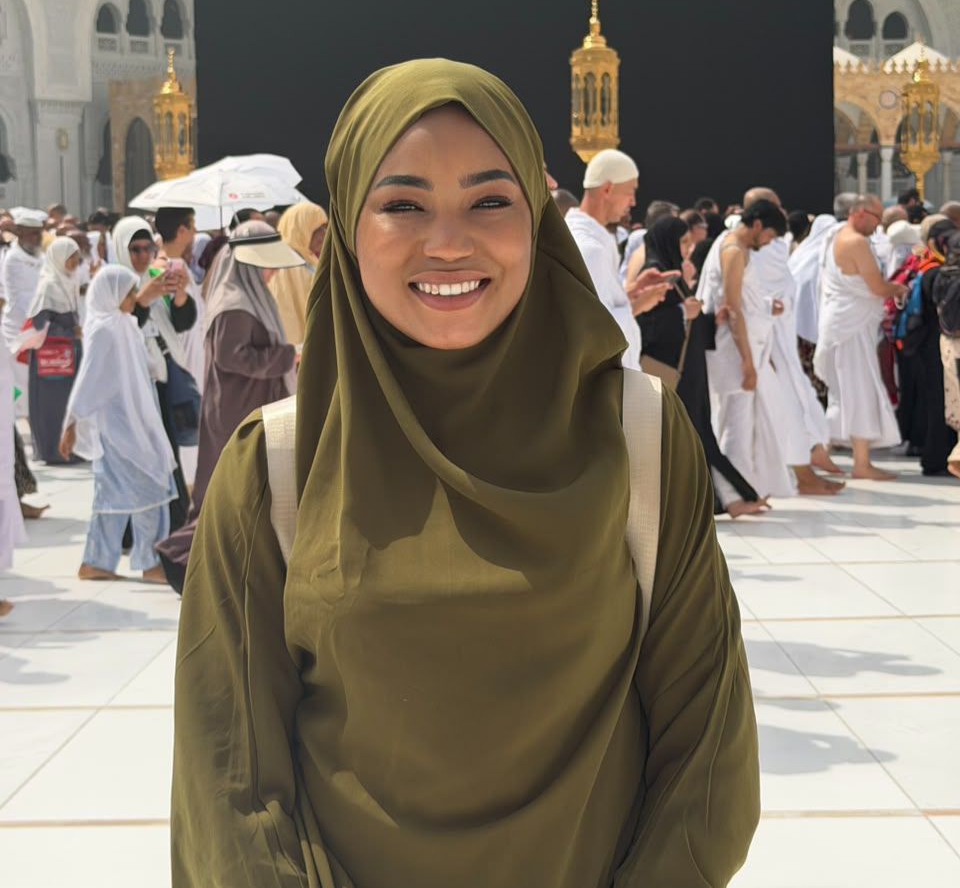
By Usman Usman Garba
Safiya Lawal Dalhat’s bold Umrah promotions are changing how many Nigerians view access to the holy journey.
For many Muslims, performing Umrah is a deeply cherished spiritual aspiration. Yet for families facing financial difficulties, the cost of visas, flights, accommodation, transportation and other travel arrangements can make the journey appear beyond their reach.
It was against this backdrop that Safiya Lawal Dalhat, popularly known as Sophy a China, decided to take a different approach to the Umrah business.
After operating her Umrah services for about two years, Safiya committed herself to periodically introducing promotional packages designed not only to attract customers but also to make the spiritual journey more accessible.
One of her most significant promotions came when she introduced a complete Umrah package—including visa, flight ticket, accommodation and transportation for ₦1.85 million.
The promotion was announced approximately four months before the scheduled departure, allowing interested customers to secure their places by paying deposits well in advance.
For Safiya, however, the promotion was about more than business.
She had observed the financial difficulties many people were experiencing.
She also encountered women who desperately wanted to take their parents to perform Umrah but lacked the financial capacity to afford prevailing market prices.
Rather than viewing the situation solely as a commercial challenge, she saw an opportunity to make a difference.
She therefore decided to use the promotional period to offer a package that would enable more people to undertake the journey.
A Bold Decision That Attracted Criticism
The decision quickly attracted attention within the Umrah and visa services space.
Safiya said some agents criticised the promotion, arguing that such pricing could disrupt the market and affect what other service providers were able to charge.
There were also public comments and insinuations questioning whether she could actually deliver a complete Umrah package for ₦1.85 million.
Safiya, however, remained firm.
Her response was simple: it was a promotion.
Rather than engage in prolonged arguments, she focused on preparing for the journey and ensuring that every aspect of the trip was properly organised.
Proof Was in the Journey
When the departure date arrived, Safiya extensively documented the process.
Through videos and other content, she showed different stages of the journey—from preparations and departure to the pilgrims’ experience in Saudi Arabia and their eventual safe return.
For her, the successful completion of the journey became the strongest response to the doubts and criticism surrounding the promotion.
There was no need for prolonged arguments.
The journey itself provided the evidence.
Customers had secured their places months earlier, travelled under the package and returned safely.
When the Market Began to Respond
According to Safiya, another significant development followed the successful promotion.
Before her ₦1.85 million offer, she observed that some Umrah packages in the market were being offered for ₦2.5 million and above.
She said that after her promotion attracted significant attention and was successfully delivered, other service providers began introducing lower prices and promotional offers of their own.
Some packages were reduced to around ₦2.3 million, others to approximately ₦2 million, while some businesses eventually introduced promotions around the same ₦1.85 million price point.
For Safiya, this was one of the clearest indications that competition could benefit consumers.
A price that had initially been questioned became part of a wider conversation about affordability and accessibility.
From ₦1.85 Million to a New Ramadan Benchmark
The development did not stop there.
Safiya later introduced another major Ramadan promotion, offering an Umrah package for ₦3.65 million.
She recalls that packages of that nature had previously been offered in the market at prices of ₦4.5 million and above.
Once again, her promotional strategy attracted attention and, according to her, other service providers subsequently introduced similar promotional pricing.
For Safiya, the significance was not simply that other businesses followed the trend.
It was the realisation that her approach could influence the wider market and encourage service providers to think differently about pricing.
Creating a New Kind of Competition
Safiya’s experience illustrates how competition can sometimes emerge not from having the biggest company, but from having the courage to experiment with a different business model.
Rather than competing solely through scale, she competed through affordability, timing, customer communication and social-media visibility.
Her online influence enabled her promotions to reach a large audience quickly.
Customers could see the packages, understand what was included, ask questions and secure their places well ahead of the journey.
That combination of social-media influence and business strategy gave her promotions a reach that traditional advertising alone might not have achieved.
More Than a Business Promotion
For Safiya, the deeper meaning of the ₦1.85 million promotion was the opportunity it created for ordinary people.
Some customers had spent years hoping to perform Umrah but had been unable to afford prevailing prices.
Others wanted to take their parents but simply lacked the resources.
By reducing the financial barrier through a carefully planned promotion, Safiya believed she was not simply selling a travel package—she was helping people fulfil a spiritual aspiration.
That perspective has become part of the identity she continues to build around her business.
A Young Entrepreneur Making an Impact
At a relatively young age, Safiya Lawal Dalhat has experienced what she describes as one of the major achievements of her entrepreneurial journey: introducing a pricing strategy that challenged established expectations within the Umrah services market.
Her story reflects a broader lesson in entrepreneurship.
Sometimes, changing an industry does not begin with a huge corporation or an established institution.
It can begin with one entrepreneur who notices that something is inaccessible, develops a different approach and has the courage to test it.
For Safiya, that courage meant introducing a ₦1.85 million Umrah package when many believed the price was impossible, standing by her decision despite criticism, delivering the promised journey successfully and continuing to develop promotional strategies.
Today, Sophy a China represents more than her identity as an entrepreneur.
Her growing influence has made her a reference point for many young business owners who see her willingness to challenge conventional practices as evidence that new ideas can create new possibilities.
Her journey in the Umrah sector is another chapter in a larger story—one built around affordability, innovation, social-media influence and the determination to create opportunities for people who might otherwise be left behind.
And perhaps the most significant achievement is not simply that she reduced a price.
It is that she helped demonstrate that when one entrepreneur is willing to challenge the status quo, an entire market can begin to reconsider what is possible.