

By Ado Umar Muhammad
The utterances of maverick politician, Dr. Rabiu Musa Kwankwaso, have recently been exceptionally indiscreet.
In an interview with representatives of radio stations in Kano not too long ago, the aspirant for the vice-presidential slot of the Nigeria Democratic Congress (NDC) in next year’s presidential election made some scathing remarks that were viewed by political observers as unbecoming of a leader.
In one of such remarks, he disparaged the state’s governor, Engr. Abba Kabir Yusuf, apparently still bitter that the governor and his supporters have parted ways with him.
He complained about betrayal and lamented that they struggled to get what rightly belonged to them (i.e. the government) only for the governor to hand it on a silver platter to his political opponents.
Kwankwaso’s hammering on the issue of betrayal every now and then seemed to have infuriated the governor to the extent that he found it necessary to counsel him against continuing the attacks to avoid forcing him to reply in the same vain.
Another shocking remark followed a question on the comments made by two former governors, Dr. Umar Abdullahi Ganduje and Malam Ibrahim Shekarau.
While Ganduje was said to have urged Kano people to vote for Governor Yusuf for a second term, Shekarau reportedly called on them to vote massively for the All Progressives Congress (APC).
The interviewer said this came at a time he (Kwankwaso) was claiming to be “in charge” of Kano votes.
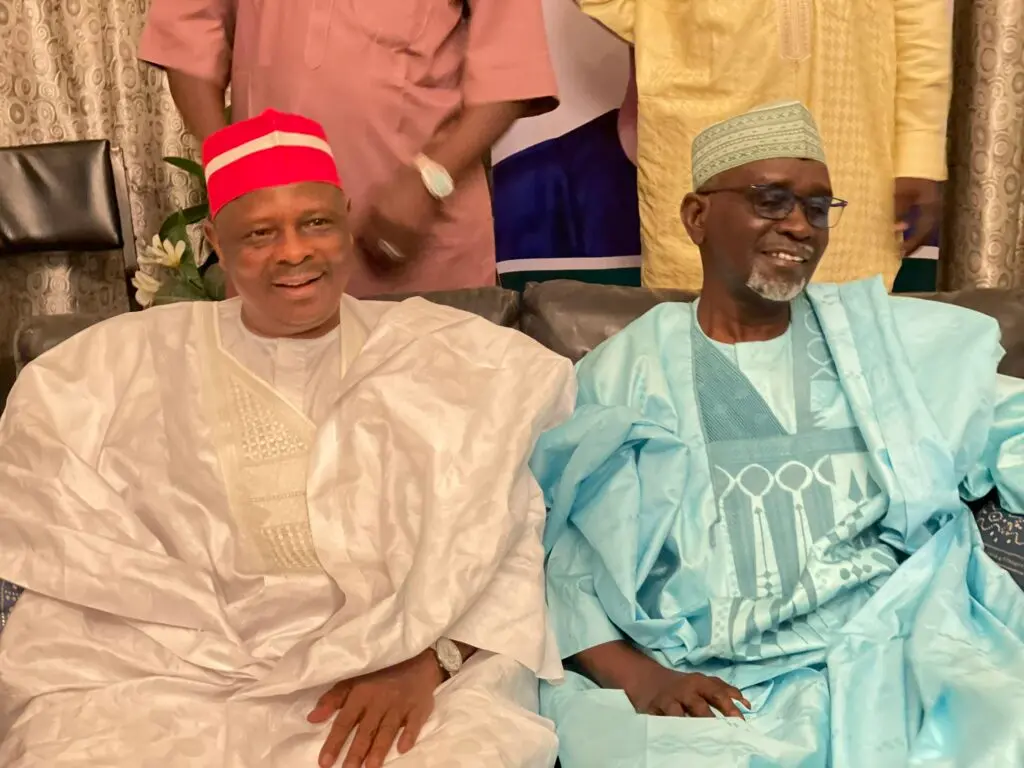
And so in his usual condescending manner, the “Madugu” lashed out at Shekarau and asked rhetorically: “Is he not the one who got 15,000 votes in an election?”
“He then told the media men to wait and see the outcome of the 2027 general elections, vowing to get 15,000 votes from his village.
“Such politicians should not be compared with me, as I am not their equal,” he boasted.
In the first place, it should be clear to all that it is wrong to say that the ex-governor got 15,000 votes in any election in the past.
Actually, it is on record that the last election Shekarau stood was for Kano Central Senatorial seat under the APC in 2019.
He won it with 506,271 votes, being 61.60 per cent of the total votes cast.
Although these detractors are aware that Shekarau did not stand for any election in 2023, they seem to love linking him with the votes Peoples Democratic Party (PDP) got in the governorship election.
This is because they saw him as the de facto leader of the party even though Alhaji Aminu Wali, with experience spanning from the Second Republic and whose son was the party’s gubernatorial candidate, was actually the state’s party leader.
However, if those making the claim mean to say that the votes resulted from his personal efforts, I have a ‘scoop’ for them.
Shekarau and some other leaders of the party did not partake in the 2023 campaigns due to certain developments.
Firstly, at the time he joined the party the choice of candidate had already been made amidst rancour between factions in the party.
Aminu Wali’s faction, which produced the candidate, was ultimately left to campaign for him.
Thus, whatever result the candidate got, should be attributed to that faction’s leader and not any of the other leaders of the party.
It would be recalled that the results of the governorship poll showed that Engr. Abba Kabir Yusuf of New Nigeria Peoples Party (NNPP) then, won the election with 1,019,602 votes; followed by Alhaji Nasiru Yusuf Gawuna of APC with 890,705 votes and Sadiq Aminu Wali of PDP came third with 15,957 votes.
Can you now see the fallacy of attributing those votes to Shekarau just because they want to belittle him in the eyes of the public?
In point of fact, besides disunity among party leaders, several other factors were responsible for PDP’s failure in 2023.
Its candidate, Sadiq Wali, was seen by people as someone lacking the requisite political stature even though as a result of a cross-party mutual understanding he served as Water Resources Commissioner from 2019-2022 under Governor Ganduje.
Secondly, and most importantly, campaign funds sent from the PDP national headquarters were routed through one of the factional leaders and aspirant for the governorship post.
He used it as a leverage to influence winning the primary election but despite his efforts he failed to clinch the ticket.
Now the outcome of that incident was clearly a major problem, isn’t it?
It produced many other problems.
This is because in frustration the man refused to release money for state-wide campaigns, which for all intents and purposes was aimed at sabotaging the efforts of the anointed candidate.
The reader might ask why the funds were routed through him.
It was because he happened to be the son-in-law of one of the topmost leaders of the party.
And when leaders of the party in the state reported his attitude to the national headquarters, their complaints were ignored.
As the national headquarters failed to resolve the issue, the factional leaders of the party and their supporters decided to withdraw from the campaigns.
The said son-in-law, rather than donate to the candidate for the success of his party, used his organizational structure to campaign for the few candidates he sponsored for other posts which they eventually lost.
Any wonder therefore why the PDP failed to perform in Kano State and could only get 15k+ votes?
Ironically, that also must have affected Atiku Abubakar’s performance negatively as the party’s presidential candidate.
Under the circumstances, is it fair to blame other leaders of the party for its failure in Kano?
And how justifiable is it for any sane person, no matter how mischievous he is, to attribute those paltry votes to someone who did not even campaign for the party’s candidate?
Your honest answer is as good as mine.
Muhammad, former Editor-in-Chief of Triumph Newspapers, wrote from Kano and can be reached via:iyaadon21@gmail.com.