

By Danasabe Danazumi Nabiyar
Rinjin Tumbau Primary School, which caters for the educational needs of pupils from neighbouring communities of Rinjin Tumbau itself, Rinjin Kartau, Sando, Dimi, Munkawa, Kanawa, Unguwar Buya, Danko and Tinidawa as well as Unguwar Iya to include Hayin Babajo and Turaki, in Galadimawa Ward of Kiru Local Government Area of Kano State, is near total collapse.
The school was established under Universal Primary Education (UPE) around 1977/1978 academic session by the then government of the state.
It started operation in the academic session of 1978/1979 under the then Peoples Redemption Party (PRP) administration led by the then governor, late Alhaji Muhammadu Abubakar Rimi.
It started with one block of two classrooms, which then contained the Headmaster’s Office and staff room.
It admitted a number of pupils, who were accommodated in the only two classes of the school.
In later years, some of its pupils were holding their classes in the open or rather under a tree as the two classes could not accommodate all of them.
The school operated for quite some years under this condition.
In fact, it operated under the same condition for over three decades.
At the moment, it has been in existence for about 47 years.
Later, when the country returned to democratic rule in 1999, the school gained another block of classrooms around 2012, to make it two blocks of four classrooms, with an additional mini block erected for nursery pupils.
Presently, each class is divided into two. Meaning that there are two blackboards in a class.
In each class, its pupils are divided into two – one backing one and the pupils are made to face the direction of their blackboards.
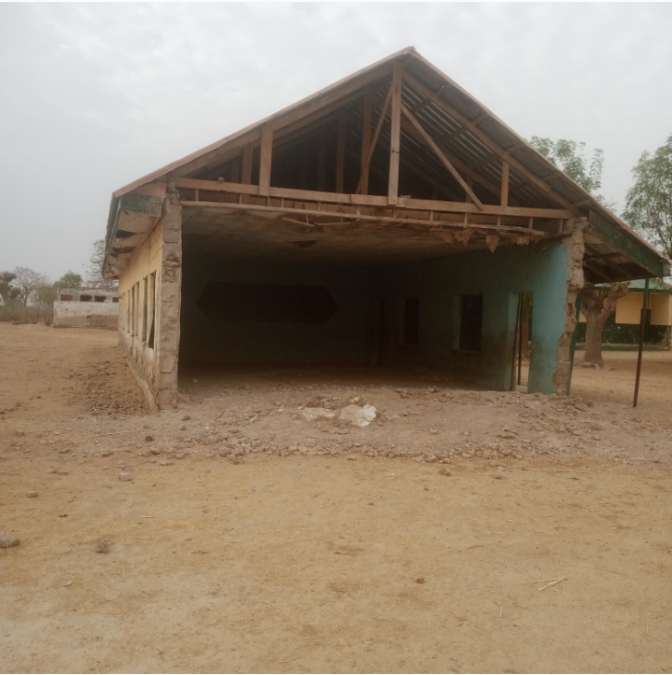
The ceilings in the classes are torn out, while their windows are supported with some local sticks where possible and necessary.
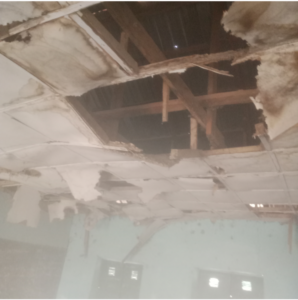
It is really a public property with less concern.
The present view of the school really irritates the mind.
The school, which was able to produce a university graduate who enrolled in the state civil service after graduation from a famous university in the country and now holds the position of a substantive director in the state civil service – now nearing retirement – has one of its walls raised down due to poor handling by the authorities – either the Local Education Area (LEA) or by extension, the State Universal Basic Education Board (SUBEB).
The wall that finally collapsed was said to be hosting one of the school’s blackboards for pupils’ learning purposes.
In fact, the school is in a serious mess of collapsed wall for some years without extending tangible efforts to rescue it by the authorities.
It was situated in a place where community support is zero.
The local authorities in charge of education in the local government area, as this writer learnt, had visited the school severally with the intention or promises of extending a helping hand to it with a view to rescuing it from total collapse, but that effort did not yield any fruit yet up to this moment.
The school remained dilapidated at the time of writing this piece.
This is happening when an emergency was declared on the education sector of the state.
But what has been deduced for sure was that almost all the schools in the state, to include those of primary and secondary standards, especially those visited in the various local government areas of the state by this writer, have one problem or the other, ranging from blown roofing, fell and cracked walls, poor floor and with lack of or inadequate chairs and desks to pave way for conducive learning and teaching atmosphere.
As a saying goes: ‘A stitch in time saves nine,’ also a visit to the school will vindicate this writer.